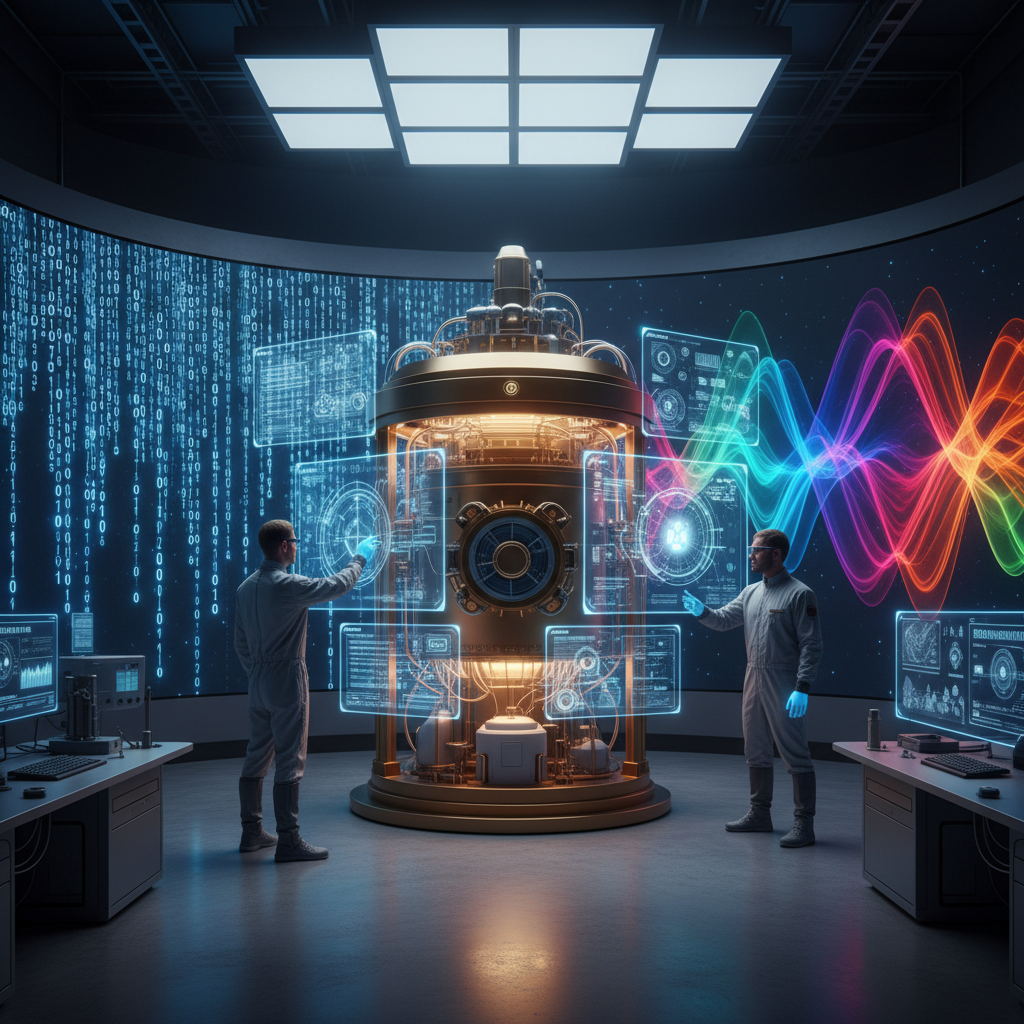
The Quantum Leap: Navigating the New Era of Computing
In recent months, the technology world has been set ablaze by major announcements from industry titans IBM and Google. Both companies have unveiled significant breakthroughs in their respective quantum processors, signaling that the race for “quantum advantage” is accelerating faster than many skeptics predicted. While the hardware—filled with cryostats, superconducting circuits, and lasers—is the star of the show, the true implications lie in the software layer and the strategic shift businesses must undergo today.
For the average software developer or business leader, quantum computing often feels like science fiction. However, as we look toward the future, the “what’s next” is becoming clearer. We are moving from a period of pure theoretical physics into an era of quantum utility. To stay ahead, professionals must begin exploring how these advancements will redefine data security, artificial intelligence, and logistics through the lens of tools like the Infinite Optimization Multi Tool, which serves as a bridge for complex computational needs.
What the IBM and Google Announcements Actually Mean
IBM recently introduced the Heron processor, which boasts significantly lower error rates than its predecessors. Meanwhile, Google continues to push the boundaries of “quantum supremacy,” demonstrating that their Sycamore processor can perform tasks in seconds that would take the world’s most powerful supercomputer thousands of years.
But why does this matter to you? For businesses, these milestones mean that the hardware is becoming stable enough to consider running real-world algorithms. We are moving away from “noisy” qubits that fail after a microsecond and toward error-corrected systems that can support complex logic. This transition is critical for developers who will eventually be tasked with writing the code that runs on these machines.
The Security Crisis: Preparing for “Q-Day”
Perhaps the most immediate and pressing impact of quantum computing is on data encryption. Modern security relies on the mathematical difficulty of factoring large prime numbers—a task that would take classical computers eons but which a sufficiently powerful quantum computer could solve in minutes using Shor’s Algorithm.
Post-Quantum Cryptography (PQC)
Businesses shouldn’t wait for “Q-Day” (the day quantum computers can break current encryption) to arrive. The strategy for “what’s next” involves:
- Audit your current data: Identify which datasets need to remain secure for 10+ years.
- Transition to PQC: Start adopting algorithms that are resistant to quantum attacks.
- Crypto-agility: Building systems where encryption methods can be swapped easily as new standards emerge.
Revolutionizing Artificial Intelligence with Quantum Speed
We are currently living through a generative AI boom, but classical hardware is reaching its physical limits in terms of power consumption and processing speed. Quantum computing offers a way out. By leveraging quantum phenomena like superposition and entanglement, AI models could theoretically process vast datasets simultaneously.
Quantum Machine Learning (QML) could allow for the training of models that are exponentially more complex than current Large Language Models (LLMs). This means AI that understands nuance, predicts market trends with uncanny accuracy, and personalizes user experiences at a molecular level. Developers looking to optimize their current workflows while preparing for this shift can utilize the Infinite Optimization Multi Tool to streamline their development pipelines today.
Complex Simulations: From Drug Discovery to Materials Science
One of the most exciting “what’s next” scenarios is in the realm of simulation. Classical computers struggle to simulate molecules because the interactions between electrons are incredibly complex. Quantum computers, which operate on the same laws of physics as molecules, are the perfect tool for this job.
Impact on Key Industries:
- Pharmaceuticals: Reducing the time it takes to discover new drugs from a decade to months by simulating molecular interactions digitally.
- Energy: Developing better superconductors and more efficient batteries for electric vehicles.
- Finance: Optimizing massive portfolios and performing risk assessments in real-time.
The Developer’s Path: Learning the Quantum Stack
If you are a software developer, you might be wondering if you need to go back to university for a physics degree. The answer is no. Major players are building abstraction layers—languages like Qiskit (IBM) and Cirq (Google)—that allow you to write quantum programs using Python-like syntax.
The transition will be gradual. We will likely enter an era of hybrid computing, where a classical CPU manages the user interface and data storage, while a Quantum Processing Unit (QPU) handles the “heavy lifting” of specific optimization tasks. To manage these hybrid environments efficiently, keeping your tech stack lean with the Infinite Optimization Multi Tool is a smart move for modern engineering teams.
Is It Too Early to Invest?
While practical, widespread quantum applications may still be 5 to 10 years away, the cost of being late is astronomical. Early adopters in the financial and chemical sectors are already filing patents for quantum-ready algorithms. For small and medium-sized businesses, the focus should be on education and security. Understanding the landscape now ensures that when the hardware catches up to the hype, your business isn’t left in the digital dust.
Conclusion: Bridging the Gap
The recent announcements from IBM and Google are not just PR stunts; they are the blueprints for the next century of computing. As quantum hardware becomes more robust, the focus shifts to the creators—the developers and strategists who will build the applications of tomorrow. By focusing on data security, AI integration, and complex simulation today, you are positioning yourself at the forefront of the next technological revolution.
Discover more from Macro Tech Titan Blog
Subscribe to get the latest posts sent to your email.